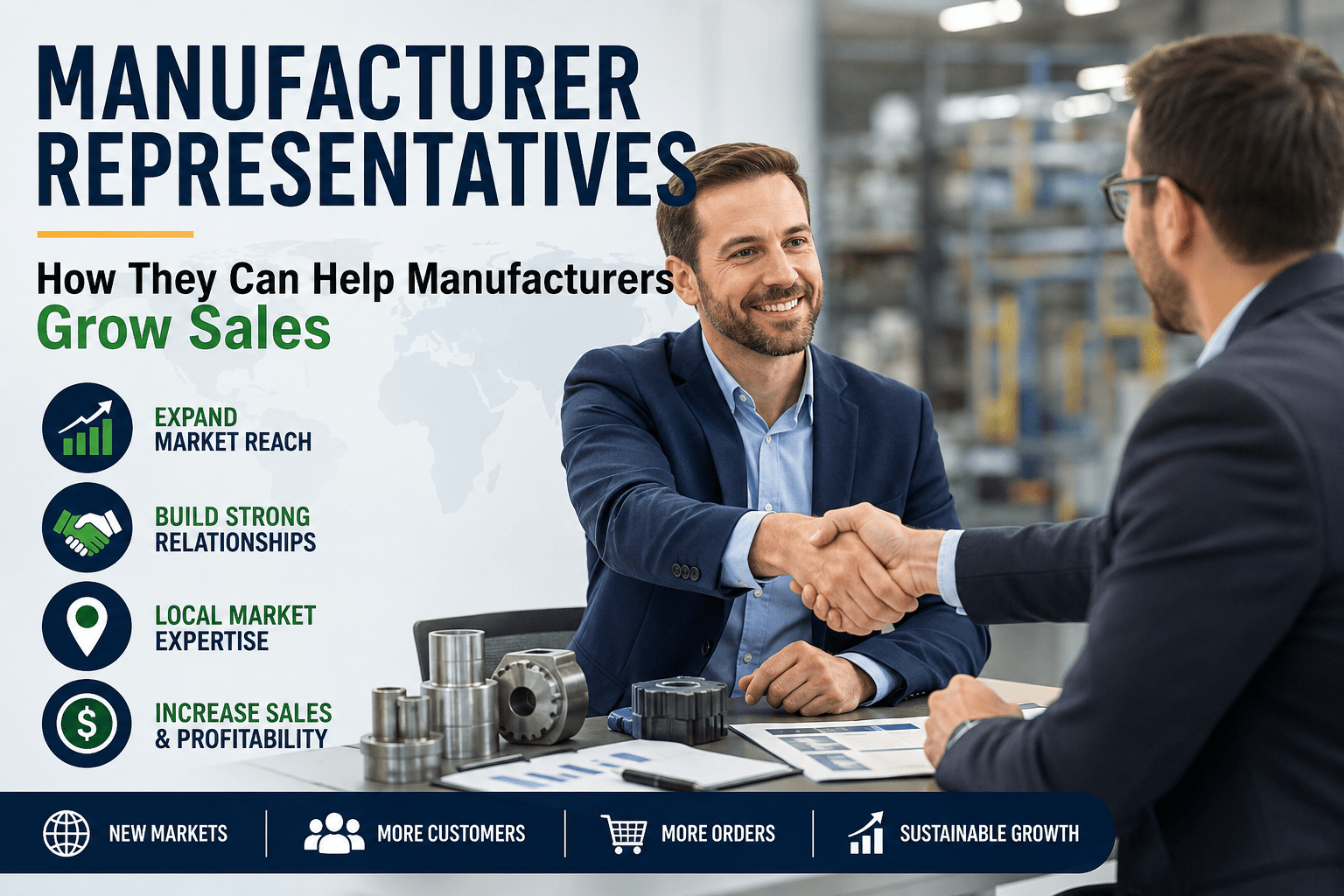
A manufacturer can have a great product, competitive pricing, and the capacity to handle more orders. But none of that automatically creates sales.
The difficult part is often getting the product in front of the right people.
Maybe you want to reach distributors in a new region. Perhaps your company wants to get in front of retailers, contractors, dealers, or commercial buyers. Or maybe you know there is demand for your product, but your current sales coverage is simply not enough.
Hiring and building a full internal sales team is one option. But it is not always the right one.
For many manufacturers, working with experienced manufacturer representatives can be a more practical way to expand into new territories and reach buyers they would otherwise struggle to access.
These representatives already work in the field. Some know a particular industry inside out. Others have spent years building relationships with distributors, dealers, and buyers in a specific territory.
The key, of course, is finding the right one.
Table of Contents
What Is a Manufacturer Representative?
A manufacturer representative, sometimes called a manufacturers’ rep or manufacturer sales rep, is an independent sales professional or agency that represents a manufacturer’s products in a particular territory, industry, or market.
Unlike an in-house salesperson, an independent manufacturer’s representative usually operates their own business.
They may represent several companies at the same time, particularly when the products are complementary and do not directly compete with one another.
For example, a representative selling products to commercial contractors might represent several manufacturers whose products are used by the same type of customer. This can allow the rep to bring multiple relevant product lines to the same buyers.
The manufacturer benefits from the representative’s sales experience and market knowledge, while the representative earns commission based on the agreed terms.
Why Do Manufacturers Work With Independent Representatives?
The biggest reason is usually market access.
Let’s say a manufacturer based in one region wants to expand into three new states. Building a sales presence from scratch in each location could take considerable time and investment.
The manufacturer needs to find the right salespeople, train them on the products, develop local knowledge, and build relationships with potential buyers.
An experienced independent manufacturer representative may already have much of that market knowledge.
That does not mean a representative can instantly guarantee sales. No serious manufacturer should expect that. But the right person may already understand who the important buyers are, how purchasing decisions are made, and what it takes to get a new product considered.
That can give a manufacturer a much stronger starting point.
How Manufacturer Representatives Can Help Grow Sales
1. They Know the Market
A representative who has worked in a particular industry for years usually understands more than just how to make a sales pitch.
They may know:
- Which companies are actively buying
- Who the decision-makers are
- Which distributors dominate the market
- What competitors are offering
- How buyers evaluate new products
- What objections are likely to come up
This kind of knowledge can be difficult to build quickly when entering a new market.
For manufacturers, local and industry-specific knowledge can sometimes be just as valuable as the representative’s actual contact list.
2. They Can Help You Enter a New Territory
Expanding geographically sounds simple on paper.
In reality, every market is different.
A sales approach that works well in one region may not work the same way somewhere else. Buying habits, competition, distribution channels, and customer expectations can all vary.
An experienced manufacturer representative who already operates in that territory can help you understand the market before you commit significant resources.
For example, instead of immediately building a large sales operation, a manufacturer might start by working with an independent representative in the new territory.
This can help answer important questions:
Is there genuine demand for the product?
Which customer segment is most interested?
Are distributors willing to carry it?
Is the pricing competitive?
What changes, if any, are needed to improve market acceptance?
Testing a market with the right sales representation can give manufacturers useful information before they make a larger investment.
3. They Bring Relevant Industry Relationships
Relationships matter in many industries.
Buyers are often approached by dozens of companies. A cold introduction from an unknown manufacturer may receive very little attention.
An introduction from a trusted representative who already works with that buyer can be different.
This is one reason manufacturers look for representatives with experience in their specific market.
However, it is important not to hire someone simply because they claim to have a “large network.”
A large network is meaningless if it is not relevant to your product.
A manufacturer selling industrial equipment, for example, needs someone who understands that buying process and works with relevant buyers. A representative with thousands of contacts in an unrelated industry may not be useful at all.
The quality of the relationships matters far more than the number.
4. They Can Expand Your Sales Coverage Without Building a Large Internal Team
Not every manufacturer needs to build a nationwide internal sales operation.
In some cases, it makes more sense to combine a small internal team with independent representatives in selected territories.
This approach gives manufacturers flexibility.
You may have strong sales coverage in your home market but limited presence elsewhere. Instead of trying to recruit and manage a large number of people immediately, you can look for experienced manufacturer representatives who already cover the markets you want to enter.
This is particularly useful when growth is gradual or when you are testing a new territory.
5. They Can Provide Valuable Market Feedback
A good representative does more than generate orders.
Because they regularly speak with buyers, they can provide useful feedback from the market.
They may tell you that customers like your product but find the pricing difficult to justify. They may discover that one particular feature is creating interest while another is rarely mentioned.
They might also identify a market segment you had not originally considered.
This feedback can help manufacturers improve their sales strategy, product positioning, pricing, and marketing materials.
The best manufacturer-representative relationships often work as a two-way exchange of information.
Manufacturer Representatives vs. an Internal Sales Team
There is no single answer that works for every manufacturer.
An internal sales team can give you more direct control over your sales process. You control the training, strategy, and day-to-day activity.
But building that structure takes time.
Independent manufacturer representatives bring a different set of advantages. They may already understand the market and have established relationships, allowing you to expand coverage without building everything from scratch.
| Internal Sales Team | Independent Manufacturer Representatives |
|---|---|
| Managed directly by the manufacturer | Operate independently |
| Requires recruiting and onboarding | Usually bring existing industry experience |
| Built specifically around your company | May represent complementary product lines |
| Greater direct control | Greater flexibility when entering new markets |
| Can take time to establish market coverage | May already have coverage in a target territory |
Some manufacturers use both.
For example, they may manage key accounts internally while working with independent representatives to cover specific regions or industries.
What Should You Look for When Hiring a Manufacturer Representative?
Finding someone with sales experience is not enough.
The right representative should make sense for your product, market, and long-term sales goals.
Here are a few things worth looking at.
Relevant Industry Experience
Ask yourself a simple question: has this person sold to the type of buyers you are trying to reach?
Industry experience can make a significant difference because the representative may already understand how those buyers think and how purchasing decisions are made.
Territory Coverage
Be specific about where you want to grow.
If your goal is to find customers in a particular state or region, look for a representative who is genuinely active there.
Do not assume that someone covers a territory simply because they are located nearby.
Existing Product Lines
Ask what other manufacturers they currently represent.
The ideal situation is often a portfolio of complementary products.
If the products directly compete with yours, there could be an obvious conflict. But if they serve the same customer base without competing, the relationship may actually create useful sales opportunities.
Relevant Buyer Relationships
Instead of asking, “How big is your network?” ask more useful questions.
Who do you typically sell to?
What type of companies do you work with?
Which industries are you active in?
How long have you been working in this market?
These answers will tell you much more about whether the representative is a realistic fit.
How Do Manufacturer Representatives Get Paid?
Many independent manufacturer representatives work on commission.
The exact arrangement varies from one agreement to another.
Some manufacturers pay a percentage of each completed sale. Others have different structures for new accounts, repeat orders, or specific product categories.
Before starting the relationship, both sides should be clear about the details.
Important points to discuss include:
- Commission percentage
- When commissions are paid
- Whether commissions are based on invoiced or collected sales
- How repeat orders are handled
- Territory boundaries
- Exclusive or non-exclusive rights
- Existing customer accounts
- What happens to commissions if the relationship ends
This is not something that should be left vague.
A clear agreement at the beginning can prevent misunderstandings later.
How to Find Manufacturer Representatives
There are several ways manufacturers can find independent sales representation.
Trade Shows and Industry Events
Trade shows can be useful because you can meet people who are already active in your industry.
You may also meet distributors, buyers, and other manufacturers who can recommend experienced representatives.
Industry Associations
Many industries have associations and professional networks that can help manufacturers connect with sales professionals.
These can be particularly useful when you are looking for someone with experience in a specialized market.
Referrals
A recommendation from a trusted distributor, customer, supplier, or industry contact can also be valuable.
A referral does not guarantee that the representative is right for your business, but it can be a useful starting point.
Online Platforms for Independent Sales Representatives
Online platforms can make the search easier, particularly when you are looking for representatives outside your immediate network.
With CommissionPeople, businesses can post commission-only sales opportunities and connect with independent sales representatives interested in representing new products and services.
A well-written opportunity should clearly explain what you are offering and who you are looking for.
How to Create a Listing That Attracts the Right Manufacturer Representatives
Experienced representatives are unlikely to respond to a vague opportunity.
Simply writing “commission sales representative wanted” does not give them enough information to decide whether your product is worth their time.
Be clear about the important details.
Explain the Product
What does it do?
What problem does it solve?
Why would a buyer choose it over existing options?
Identify the Target Customer
Be specific.
Are you selling to distributors, retailers, contractors, manufacturers, or another type of buyer?
The more clearly you define the target market, the easier it is for the right representatives to identify the opportunity.
Explain the Commission Structure
Do not make people guess.
Provide enough information for an experienced representative to understand the potential of the opportunity.
Mention the Territory
Clearly state where you are looking for representation.
For example, you may be looking for representatives in specific states, across the United States, or in particular international markets.
Explain the Support You Provide
Representatives need information and resources to sell effectively.
Depending on your product, this might include:
- Product training
- Samples
- Marketing materials
- Pricing information
- Technical support
- Sales presentations
The easier you make it for a representative to understand and present your product, the better prepared they will be to take it to potential buyers.
Common Mistakes Manufacturers Make
Hiring Based Only on a Large Network
A representative may know hundreds of people, but if those contacts are not your potential buyers, the network will not help much.
Always look for relevance.
Offering a Product With No Clear Sales Story
Even the most experienced representative cannot easily sell a product if the value proposition is unclear.
Before looking for sales representation, make sure you can clearly explain why customers should buy your product.
Providing Too Little Information
Representatives need accurate product details, pricing, and answers to common buyer questions.
If they have to chase the manufacturer for basic information, the sales process becomes unnecessarily difficult.
Expecting Immediate Results
Sales cycles vary.
A representative may need time to learn the product, introduce it to buyers, follow up, and move opportunities through the buying process.
The relationship should be evaluated realistically, based on the product and the market.
Choosing the Wrong Fit
Sometimes a highly experienced representative is simply not the right person for a particular product.
Industry fit, territory, buyer relationships, and product compatibility are all important.
Is Working With a Manufacturer Representative Right for Your Business?
Working with an independent manufacturer’s representative may make sense if you want to:
- Expand into a new territory
- Reach a specific type of buyer
- Improve sales coverage
- Enter a new industry
- Test a market before making a larger investment
- Work with experienced independent sales professionals
- Grow without immediately building a large internal sales operation
The important thing is to approach the process strategically.
Do not just look for “someone who can sell.”
Look for someone whose experience matches the market you want to enter.
Final Thoughts
Manufacturer representatives can be an effective part of a manufacturer’s growth strategy, especially when entering new territories or trying to reach buyers outside an existing network.
The right representative can bring market knowledge, relevant relationships, and a better understanding of how customers in that industry buy.
But simply hiring a representative is not enough.
Manufacturers still need to provide a product with a clear value proposition, reasonable sales potential, accurate information, and ongoing support.
When both sides are a good fit, independent sales representation can give manufacturers a practical way to expand their reach without building every part of the sales operation from the ground up.
Looking for Manufacturer Representatives?
If your business is looking to expand into new markets, CommissionPeople can help you connect with independent and commission-only sales representatives.
Create an opportunity that clearly explains your product, target market, territory, and commission structure. This makes it easier for relevant representatives to understand your business and decide whether the opportunity is a good fit.
Post your commission-only sales opportunity on CommissionPeople and connect with independent sales representatives who may be interested in representing your product.
Frequently Asked Questions About Manufacturer Representatives
What is a manufacturer representative?
A manufacturer representative is an independent sales professional or agency that represents a manufacturer’s products and works to connect those products with relevant buyers, distributors, dealers, retailers, or other customers.
What is the difference between a manufacturer representative and an internal sales team?
An internal sales team works directly within the manufacturer’s organization. An independent manufacturer representative operates independently and may represent multiple complementary product lines.
How do manufacturer representatives make money?
Many manufacturer representatives are compensated through commissions based on the sales covered by their agreement with the manufacturer.
Can one manufacturer representative represent multiple companies?
Yes. Independent representatives often represent several manufacturers, particularly when the products are complementary and do not directly compete.
How can manufacturers find independent manufacturer representatives?
Manufacturers can look through industry events, trade shows, referrals, professional networks, industry associations, and online platforms such as CommissionPeople.
Should I give a manufacturer representative an exclusive territory?
That depends on your sales strategy and the agreement you create. Before granting exclusivity, clearly define the territory, expectations, performance requirements, and terms of the relationship.