When a business wants to increase sales, one important decision is choosing the right sales model.
Should you build a traditional sales team and manage sales internally? Or should you work with independent sales representatives who already have industry experience, customer relationships, and market knowledge?
Both approaches can work. The right choice depends on your products, target customers, territories, growth plans, and sales strategy.
For manufacturers, wholesalers, distributors, and growing businesses, understanding how independent sales representatives compare with traditional sales teams can help you choose a sales approach that fits your business.
Table of Contents
What Is an Independent Sales Representative?
An independent sales representative is an independent sales professional who represents products or services for businesses.
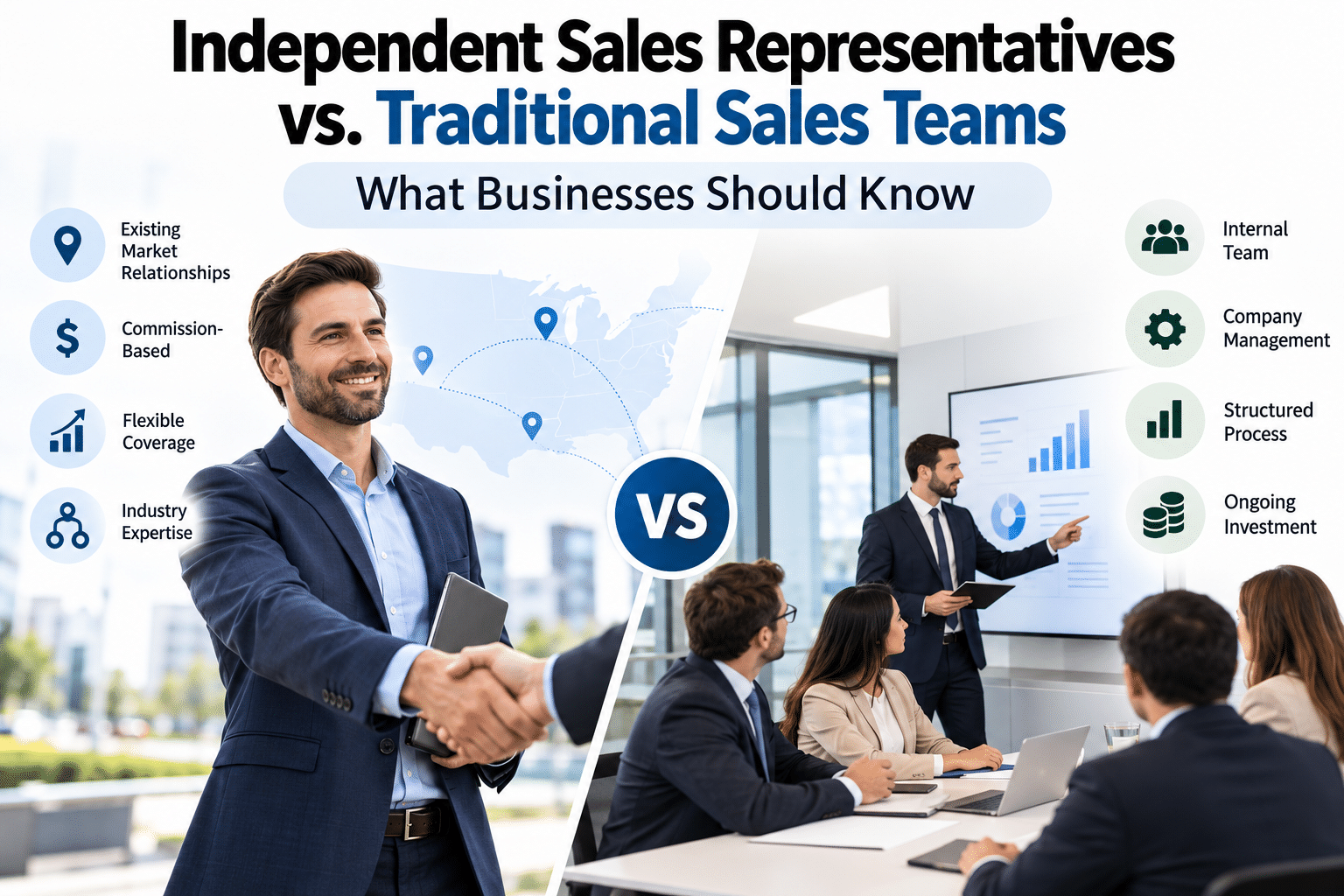
Independent sales reps commonly work on a commission-based or commission-only arrangement. Instead of being part of a company’s internal sales operation, they manage their sales activities independently and may represent complementary products from multiple companies.
Many experienced independent sales representatives already have relationships within specific industries or territories. They may understand the buyers, distribution channels, purchasing process, and competitive environment in their market.
For businesses looking to expand their sales reach, this existing experience can provide a valuable starting point.
What Is a Traditional Sales Team?
A traditional sales team is an internal sales operation managed directly by the business.
The company typically handles recruiting, training, sales management, territory planning, sales technology, reporting, and other resources required to support the sales process.
One of the biggest advantages of this model is direct control. Businesses can establish their own sales process and manage how representatives approach customers and handle opportunities.
However, building and maintaining an internal sales operation also requires ongoing investment and management.
Independent Sales Representatives vs. Traditional Sales Teams
The biggest difference is how the sales operation is structured.
With independent sales representatives, businesses can add sales coverage without necessarily building an entire internal sales department.
With a traditional sales team, the business develops and manages its own sales organization.
Neither model is automatically right for every business. The better option depends on what the company needs at its current stage of growth.
1. Cost and Sales Investment
Sales growth requires investment, but the type of investment can differ significantly between the two models.
Building a traditional sales team may require resources for recruiting, training, management, sales tools, travel, and ongoing sales operations.
Independent sales representatives often work under a commission-based structure. This allows businesses to connect sales compensation more directly with sales results.
For a company that wants to expand into a new territory without immediately building a large internal sales operation, this can provide additional flexibility.
However, businesses should carefully evaluate commission structures, territories, expected sales volume, and the overall economics of the sales relationship before making a decision.
2. Existing Market Relationships
One of the most valuable advantages an experienced independent sales representative can bring is an existing network.
A rep who has spent years working within an industry may already know:
- Potential buyers
- Distributors
- Wholesalers
- Retailers
- Purchasing decision-makers
- Industry contacts
- Relevant sales channels
This can be particularly useful when a business wants to enter a market where it does not yet have strong sales coverage.
A traditional sales team can build these relationships over time, but establishing a new network can require significant effort.
3. Flexibility for Business Growth
Markets change, and businesses often need to adjust their sales strategy.
A company may want to test a new territory, introduce a product to another industry, or increase sales coverage in a specific region.
Working with independent sales representatives can provide businesses with additional flexibility in these situations.
Instead of immediately creating a complete internal sales operation, a company can look for independent reps with experience in the specific territory or market it wants to develop.
This makes independent sales representatives an option worth considering for businesses that want to expand strategically.
4. Industry Experience Matters
A sales representative needs more than general selling ability.
For many B2B products, understanding the industry is just as important as understanding the sales process.
An experienced independent sales representative may already understand:
- How customers make purchasing decisions
- Which products customers typically compare
- How distribution works in the industry
- Common customer challenges
- Competitive products
- Important industry relationships
- How to communicate with specific types of buyers
This experience can help a business enter a market with a more informed sales approach.
5. Market Expansion
Expanding into a new territory can be challenging when a company has no existing customer base there.
An independent sales representative with established territory knowledge can potentially help a business develop sales opportunities in that market.
For example, a manufacturer may have strong sales in one region but limited coverage in another. Instead of immediately building an internal sales operation for the new territory, the company could look for an independent sales rep who already works with relevant buyers in that market.
This approach can be especially useful for businesses that want to test new markets before making a larger investment.
6. Management and Control
Traditional sales teams provide businesses with direct management.
The company can establish sales procedures, monitor activities, provide training, set priorities, and manage day-to-day sales operations.
Independent sales representatives operate with more independence.
That means businesses should establish clear expectations before starting the relationship.
Important areas to define include:
- Territory
- Products or product lines
- Commission structure
- Target customers
- Sales responsibilities
- Communication expectations
- Reporting requirements
- Terms of the sales relationship
Clear communication helps both the business and the independent sales representative understand what is expected.
7. Speed of Building Sales Coverage
Creating a new internal sales team takes time.
The business needs to find the right people, train them, establish sales processes, provide resources, and develop market knowledge.
An experienced independent sales representative may already have many of these market connections.
This does not guarantee immediate sales, but it can give a business an established starting point when entering a new market.
For businesses focused on expanding sales coverage efficiently, this can be an important consideration.
When Should a Business Consider Independent Sales Representatives?
Independent sales representatives can be a good option for businesses that want to:
- Enter new territories
- Expand into new markets
- Increase sales coverage
- Reach new types of buyers
- Access established industry relationships
- Launch products in additional markets
- Work with a commission-based sales model
- Expand without immediately building a large internal sales operation
They can be particularly relevant for manufacturers, wholesalers, distributors, and B2B companies where relationships and industry knowledge play an important role in generating sales.
When Might a Traditional Sales Team Be the Better Choice?
Independent sales representatives are not the only sales model available to businesses.
A traditional internal sales team may make more sense when a company requires:
- Direct day-to-day management
- Dedicated internal sales resources
- A highly structured sales process
- Extensive company-specific training
- Close control over customer interactions
- A long-term internal sales organization
Businesses should consider their sales goals, products, market, resources, and preferred management structure before choosing an approach.
Can a Business Use Both Sales Models?
Yes.
Businesses do not necessarily have to choose between independent sales representatives and traditional sales teams.
A company can use both models as part of a broader sales strategy.
For example, an internal sales team could manage existing key accounts while independent sales representatives focus on developing new territories.
Another business could use its internal team for direct customer relationships while independent reps focus on distributors, wholesalers, retailers, or specialized markets.
This type of approach can give businesses additional sales coverage while maintaining an internal sales operation.
How to Find the Right Independent Sales Representative
Finding an independent sales representative is not simply about finding someone who is available.
The most important factor is fit.
Before choosing a rep, businesses should consider their:
Industry Experience
Does the representative understand your industry and product category?
Territory
Does the rep already have relationships in the market you want to develop?
Customer Network
Does the representative have access to the types of customers you want to reach?
Product Compatibility
Do your products complement the other products the representative already represents?
Sales Experience
Does the representative have experience selling similar products or working with similar buyers?
Market Knowledge
Does the rep understand the competitive environment and purchasing process?
The right independent sales representative should have a strong connection between their experience, territory, customer network, and your business opportunity.
How Businesses Can Expand Their Sales Network
Finding qualified sales representatives can be challenging when a business relies only on personal contacts or general outreach.
A specialized platform can make it easier for businesses to present their opportunity to independent sales professionals who are actively looking for products and companies to represent.
Instead of starting from zero, businesses can create a clear opportunity listing that explains their products, target market, territory, and sales requirements.
This gives independent sales representatives the information they need to determine whether an opportunity fits their experience and customer network.
What Should a Business Include in a Sales Opportunity?
A strong opportunity listing should clearly explain what the business is offering.
Consider including:
- Product or service description
- Target industry
- Ideal customers
- Available territories
- Sales channel
- Commission structure
- Existing market presence
- Sales experience requirements
- Contact or application process
The more clearly the opportunity is presented, the easier it becomes for relevant independent sales representatives to evaluate it.
Independent Sales Representatives Can Be a Flexible Sales Growth Option
Traditional sales teams remain an important option for businesses that want direct control over their sales operation.
However, independent sales representatives can give businesses another way to expand market coverage, access industry relationships, and develop new sales opportunities.
For manufacturers, wholesalers, distributors, and other B2B companies, the decision should not simply be about choosing one sales model over another.
Instead, businesses should consider where they want to grow, what resources they have available, and which sales approach fits their objectives.
In some situations, an internal sales team may be the right choice. In others, independent sales representatives may provide the flexibility and market access the business needs.
For many companies, using both approaches can also be a practical way to expand sales coverage.
Find Independent Sales Representatives for Your Business
If your business is looking to expand its sales network, CommissionPeople provides a platform where businesses can list their sales opportunities and connect with independent sales representatives.
Whether you are entering a new territory, launching a product, or looking for additional sales coverage, you can create an opportunity listing and reach independent sales professionals who are looking for products and companies to represent.
List your sales opportunity on CommissionPeople and expand your sales network.
Frequently Asked Questions
What is an independent sales representative?
An independent sales representative is an independent sales professional who represents products or services for businesses, commonly under a commission-based arrangement.
What is the difference between an independent sales representative and a traditional sales team?
An independent sales representative operates independently and commonly works on a commission-based arrangement, while a traditional sales team is managed directly as part of the company’s internal sales operation.
Why do businesses hire independent sales representatives?
Businesses may hire independent sales representatives to expand into new territories, access established industry relationships, increase sales coverage, and reach new markets.
Are independent sales representatives useful for manufacturers?
Yes. Independent sales representatives can be useful for manufacturers that want to reach distributors, wholesalers, retailers, and other B2B buyers in specific industries or territories.
Can a business work with multiple independent sales representatives?
Yes. Businesses can work with representatives covering different territories, industries, or customer segments, provided the sales arrangement and territories are clearly defined.
Can a business use independent sales reps and a traditional sales team?
Yes. A business can use an internal sales team for existing accounts and independent sales representatives for new territories, markets, or customer segments.
How can I find independent sales representatives?
Businesses can use specialized platforms such as CommissionPeople to list their sales opportunities and connect with independent sales representatives looking for products and companies to represent.