If you’ve been thinking about expanding your sales team, you’ve probably faced the same question that thousands of manufacturers and business owners ask every year:
Should we hire full-time salespeople, or is there a smarter way to grow?
For many companies, hiring another employee feels like the obvious next step. But once you calculate salaries, benefits, travel expenses, software licenses, onboarding, and the months it can take before a new salesperson closes their first deal, that decision becomes much more complicated.
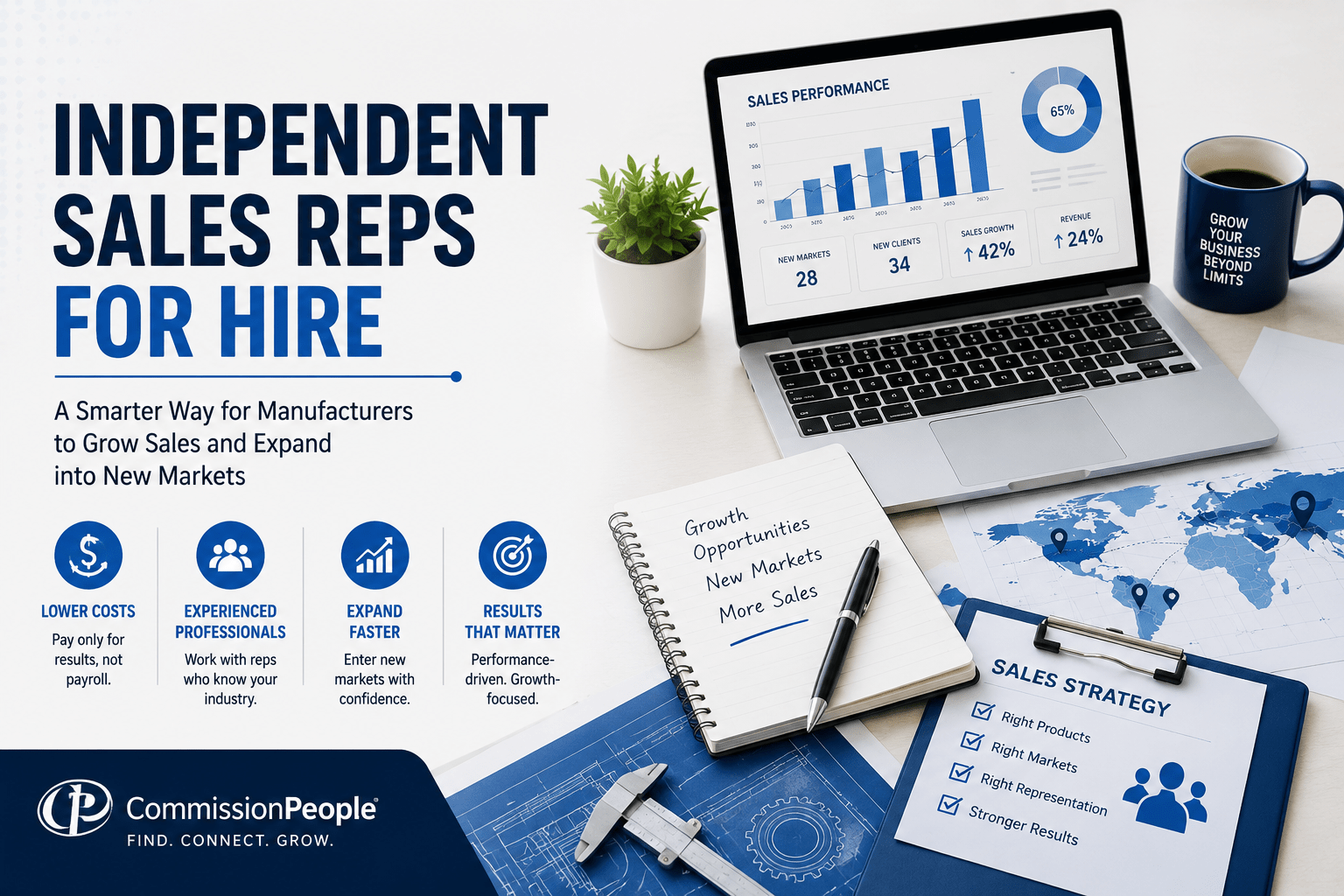
That’s exactly why more manufacturers are turning to independent sales reps for hire instead of expanding their payroll.
Rather than investing heavily before seeing results, businesses are choosing experienced professionals who already know their industries, understand their territories, and earn income only when they generate sales.
It’s a model that’s been helping manufacturers grow for decades—and it’s becoming even more relevant in today’s economy.
Table of Contents
The Hidden Cost of Hiring a Full-Time Salesperson
Most hiring decisions start with salary, but salary is only part of the investment.
A new sales employee often requires:
- Recruitment costs
- Interviews and onboarding
- Product training
- CRM access
- Travel expenses
- Health benefits
- Payroll taxes
- Sales management
- Months of coaching before becoming productive
Even after making that investment, there’s no guarantee the person will succeed.
Many business owners discover that their biggest expense isn’t paying a salesperson—it’s paying one who isn’t generating enough business.
That’s where commission-only sales representatives offer a different approach.
What Are Independent Sales Representatives?
Independent sales representatives are self-employed professionals who sell products on behalf of manufacturers and suppliers.
Unlike employees, they aren’t on your payroll.
Instead, they earn commissions based on the business they generate.
Many represent several complementary product lines, allowing them to offer complete solutions to customers while expanding opportunities for the manufacturers they represent.
Because they’ve often spent years building relationships with distributors, retailers, contractors, purchasing managers, and decision-makers, they can open doors much faster than someone starting from scratch.
For manufacturers, that experience can be just as valuable as the product itself.
Why Manufacturers Continue to Use the Manufacturer Representation Model
The manufacturer representation model has been around for decades, and for good reason.
Many industries still rely on independent representatives because they understand local markets better than anyone else.
You’ll commonly find manufacturer representatives working in industries such as:
- Industrial equipment
- Electrical products
- Construction materials
- Packaging
- Medical devices
- Consumer goods
- Automotive components
- HVAC equipment
- Food service supplies
Instead of hiring separate employees for every region, manufacturers can work with experienced representatives who already have established customer relationships.
That reduces both cost and time.
A Real-World Situation Many Businesses Face
Imagine you’re a manufacturer based in Ohio.
You’ve built a great product, your current customers are happy, and you know there’s demand in Texas, Florida, and California.
Hiring three regional sales managers could easily cost hundreds of thousands of dollars each year before you see meaningful revenue.
Instead, you connect with three independent sales representatives who already sell complementary products in those territories.
They already visit distributors.
They already know buyers.
They already understand the local market.
Instead of spending months building relationships, you’re building on relationships that already exist.
That’s one reason independent representation continues to work so well.
Why More Companies Hire Sales Reps on Commission
Every business wants predictable growth.
Unfortunately, sales rarely work that way.
When companies hire a salesperson on commission, they’re aligning compensation with performance.
That doesn’t eliminate every risk, but it does reduce one of the biggest financial concerns—paying fixed salaries before revenue arrives.
Commission-only representatives are motivated by the same goal as the manufacturer:
Growing sales.
When they succeed, both sides benefit.
What Makes a Great Independent Sales Representative?
Not every sales representative will be the right fit.
The best ones usually have a combination of experience, relationships, and market knowledge.
When evaluating candidates, consider questions like:
- Do they already work within your industry?
- Which territories do they actively cover?
- What customer relationships have they built?
- Are they representing competing products?
- How long have they worked in the market?
- Can they provide references from manufacturers they’ve represented?
The answers often reveal far more than a résumé.
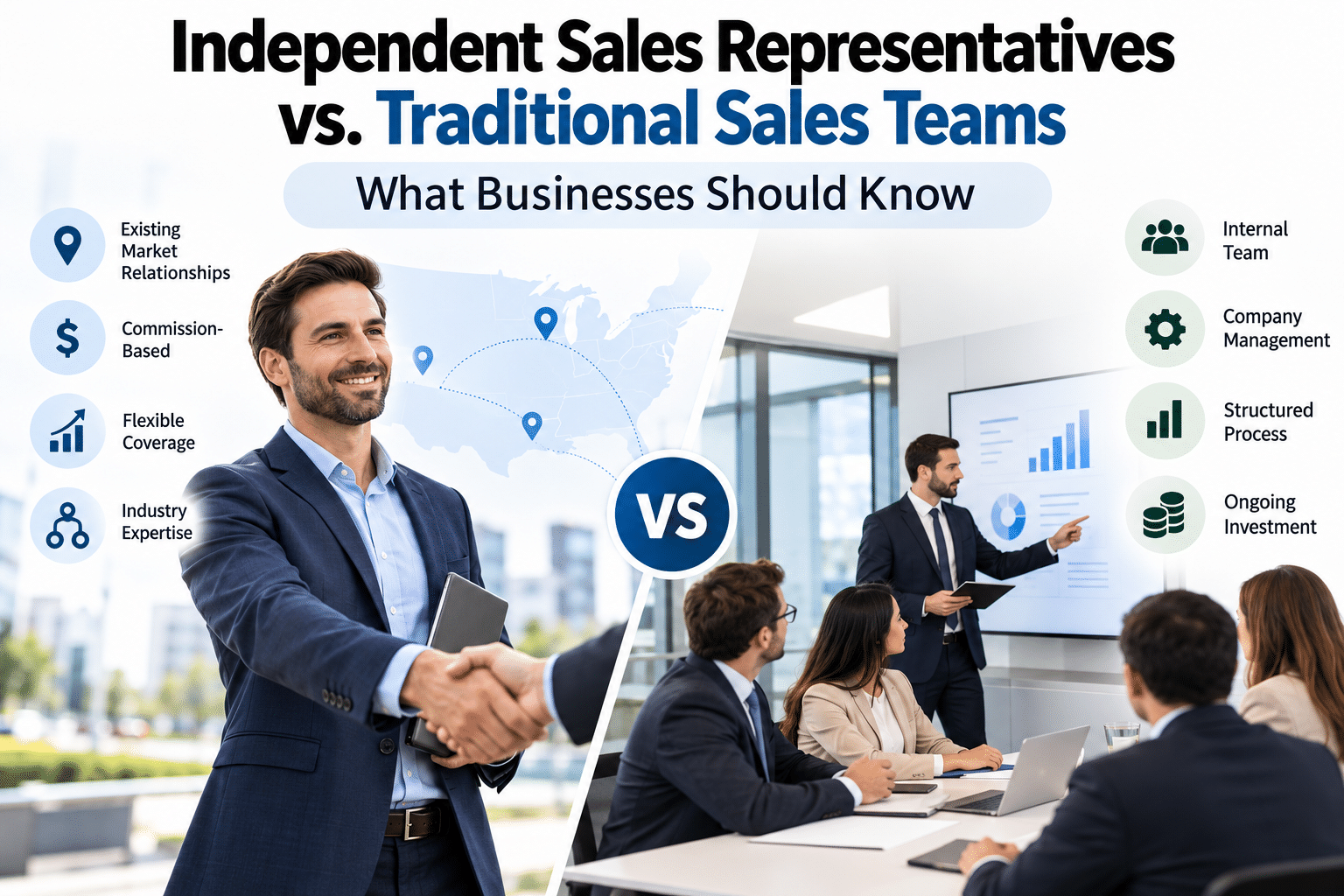
Freelance Sales Reps vs. Full-Time Employees: Which Is Right for Your Business?
There isn’t a one-size-fits-all answer. The right choice depends on your business goals, budget, and growth strategy.
If you’re planning to build an in-house sales department with long-term management and support, hiring full-time employees may be the right investment. They work exclusively for your company, follow your internal processes, and can become deeply involved in your business over time. However, this approach also comes with higher fixed costs, including salaries, benefits, training, and ongoing management.
Freelance or independent sales reps work differently. They operate as self-employed professionals and are typically paid through commissions on the sales they generate. Because they often represent complementary product lines and already have relationships with buyers in their territory, they can help manufacturers enter new markets without the financial commitment of hiring additional employees.
For many manufacturers, especially those testing new regions or launching new products, independent sales reps offer a practical way to grow sales while keeping overhead under control. Instead of investing heavily upfront, businesses can focus their resources on rewarding actual sales performance.
Ultimately, neither model is universally better. Full-time employees make sense for companies that need dedicated internal resources, while independent sales representatives are often the smarter choice for businesses looking to expand efficiently, reduce hiring risks, and accelerate market reach.
Common Mistakes Manufacturers Make
Over the years, one pattern appears again and again.
Businesses focus almost entirely on finding someone who can sell.
But successful partnerships depend on much more than sales ability.
Common mistakes include:
Choosing the Lowest Commission Rate
A lower commission doesn’t necessarily mean lower costs.
An experienced representative who consistently closes business usually delivers a much better return than someone charging less but producing little.
Providing Very Little Product Training
Even experienced sales professionals need to understand your products.
The better they understand your competitive advantages, the more effectively they can position your solutions.
Expecting Immediate Results
Relationship-based selling takes time.
Independent representatives often already know the right buyers, but major purchasing decisions rarely happen overnight.
Patience is part of the process.
Ignoring Communication
The strongest manufacturer-representative partnerships include regular product updates, pricing information, marketing support, and clear expectations.
Representatives should feel like an extension of your business—not an afterthought.
Signs You’re Ready to Hire Independent Sales Reps
Your business may be ready if:
- Sales growth has stalled.
- You’re entering new territories.
- You want to reduce payroll expenses.
- Your products have strong margins.
- You already have proven demand.
- You need better distributor coverage.
- You’re launching new product lines.
If several of these sound familiar, independent representation could be worth exploring.
How to Find Independent Sales Reps for Hire
Finding the right representative isn’t just about posting an opportunity online.
It’s about reaching professionals who actively work within your industry.
Look for representatives who:
- Understand your products.
- Cover your target territories.
- Have an established customer base.
- Communicate professionally.
- Have experience representing manufacturers similar to yours.
Taking the time to evaluate the right fit usually produces better long-term partnerships than simply hiring the first available candidate.
Why This Sales Model Continues to Grow
Business owners today are under constant pressure to increase revenue while controlling costs.
Adding permanent employees isn’t always the best solution.
Independent sales representatives allow manufacturers to expand strategically, enter new markets more efficiently, and focus investments where they matter most—winning new business.
That’s why companies across manufacturing, industrial products, consumer goods, and wholesale distribution continue to rely on commission-only sales professionals.
The model isn’t new.
It’s simply proving its value again and again.
Final Thoughts
Every manufacturer wants growth, but sustainable growth requires smart decisions.
Hiring full-time employees will always make sense for some businesses.
For others, working with experienced independent sales reps for hire offers a practical alternative that reduces financial risk while creating opportunities to expand into new markets.
The key isn’t simply finding someone who can sell.
It’s finding someone who already understands your industry, has earned the trust of buyers, and can represent your products with confidence.
When those pieces come together, a commission-only sales relationship can become one of the most valuable investments your business makes.
FAQs
Are independent sales reps employees?
No. Independent sales representatives are self-employed professionals who typically earn commissions based on the sales they generate.
Is hiring commission-only sales reps suitable for small manufacturers?
Yes. Many small and mid-sized manufacturers choose commission-only representatives because they can expand sales without adding permanent payroll costs.
What industries commonly use manufacturer representatives?
Industrial equipment, medical devices, packaging, electrical products, automotive components, construction materials, consumer goods, and many other manufacturing sectors regularly work with independent sales representatives.
How long does it take to see results?
The timeline depends on your industry, sales cycle, and market. Representatives with existing relationships can often create opportunities more quickly than newly hired employees, but complex B2B sales still require time to close.